
Bathing in heat for cleansing, purification, healing, social, and spiritual purposes is an ancient practice, which has been practiced for thousands of years and across many cultures. Variations of its use are still practiced today in different cultures, such as the saunas of Finland, the sweat lodges of the American Indians, the banyas of Russia and the Turkish hamman.
Sauna use is also known as sauna bathing and is characterized by short-term exposure to high temperatures that induces a thermoregulatory response in the body that influences various mechanisms in the body.
The term “sauna” is a Finnish word which typically refers to an unpainted spruce- or pine paneled room with wooden benches. Historically, saunas were heated by wood fires, but most modern saunas are heated by electrical heaters or infrared heaters. Conventional electrical heaters warm the air from 70 oC to 100 oC at the level of the user’s face and the heat transfers to the body. Infrared heaters, on the other hand, emit either near or far infrared wavelengths. The thermal radiation they emit heats the body directly and at lower temperatures than traditional saunas, at 45 oC to 60 oC. Exposure times are usually 5-20 minutes, and sauna bathing can involve rituals of cooling off periods and rehydration with oral fluids. Some of these cooling methods involve rolling in snow or immersing in cold water, which further stresses the cardiovascular system.
Saunas are generally classified as “dry” or “wet”. In a dry sauna, the relative humidity is low at 10-20% and a common practice in Finland is to apply water to the heater’s rocks to slightly increase the humidity. A wet sauna actually refers to a steam sauna, in which the humidity is extremely high at more than 50%, which impairs sweat evaporation and may elicit greater strain on the cardiovascular system.
The body’s major responses to heat from sauna use:
Short-term exposure to high temperatures elicits mild hyperthermia, which induces a thermoregulatory response that involves cardiovascular, neuroendocrine, and cytoprotective mechanisms. These mechanisms work in a synergistic way in an attempt to maintain homeostasis in the body.
Repeated sauna use acclimates the body to higher temperatures and improves the body’s response to future exposure, deemed to be due to a biological phenomenon known as hormesis, which can be likened to preconditioning the body for similar future events.
During sauna use the body stresses due to high temperature and elicits a rapid response that primarily affects the skin and cardiovascular systems. The skin heats first and is followed by core body temperature rising slowly from 37 oC to approximately 39 oC. Cardiac output may increase by as much as 60-70%, with the heart rate increasing and the stroke volume remaining stable. At the same time about 50-70% of the blood circulation redistributes from the core to the skin, to facilitate sweating, which results in fluid losses of approximately 0,6 to 1.0 kg per hour during a moderate temperature (80-90 oC) Finnish-style sauna session. The acute heat exposure causes an increase in overall plasma volume to cushion the decrease in core blood volume.
Sweating cools the body to prevent rapid increases in core body temperature and promotes heat tolerance. Sweating also enables a higher excretion of certain heavy metals, such as lead, aluminum, cobalt, and cadmium.
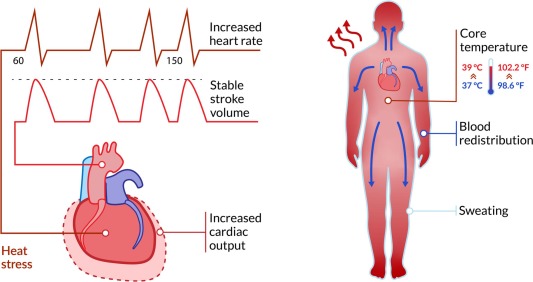
Heat stress increases core body temperature, promotes blood redistribution, and increases sweat production. Heart rate and cardiac output increase, while stroke volume remains stable.
Heat shock proteins: Stressful environmental conditions, such as temperature extremes, can result in cellular proteins unfolding or becoming damaged, impairing their normal functions. One of the protective responses to heat stress is the increased expression of heat shock proteins, which are present in all cells, to prevent protein disorder and clumping in cells, by repairing damaged proteins. Increased expression of heat shock proteins may also provide protection against chronic diseases, slow muscle atrophy, and promote longevity.
Nuclear factor erythroid 2-related factor 2 (Nrf2): Nrf2 is a key regulator of the antioxidant response of cells. Whole body hyperthermia, such as sauna use, increases the expression of Nrf2, which leads to the orchestrated regulation of a vast network of genes with antioxidant and anti-inflammatory functions.
Interleukin-6 and interleukin-10: Inflammation is part of the body’s immune system’s response, but chronic inflammation contributes to many chronic diseases. Maintaining a balance of pro- and anti-inflammatory factors is crucial for the development and subsequent resolution of an inflammatory response. Interleukin-6 is a pro-inflammatory cytokine, while interleukin-10 is an anti-inflammatory cytokine. Sauna use and exercise both elevate body temperature, which acutely increases both interleukin-6 and interleukin-10 plasma levels.
Health effects of sauna use:
Sauna bathing has emerged in recent decades as a probable way to increase healthspan. While lifespan refers to the total duration of a person’s life, healthspan refers to the period within that life spent in good health, free from chronic disease and disability. Data from observational, interventional, and mechanistic studies support the claims that sauna use extend healthspan. The most comprehensive of these studies, the Kuopio Ischemic Heart Disease (KIHD) Risk Factor Study, followed the health outcomes of more than 2300 middle-aged men from eastern Finland for more than 20 years, and has identified associations between sauna use and reduced risk for age-related impairments such as cardiovascular disease, neurodegenerative disease, immunological decline, and metabolic dysfunction.
Protection against cardiovascular disease: Increasing evidence from studies suggest that cardiovascular disease is largely preventable by implementing a healthy lifestyle, which includes regular exercise, a healthy diet, and stress management. Regular sauna use has emerged as a healthy lifestyle practice and primary prevention strategy that may reduce the risk of cardiovascular disease and related mortality.
Long-term sauna use brings about protective responses against the pathological processes that drive cardiovascular processes, by decreasing resting systolic and diastolic blood pressure; increasing left ventricle ejection fraction (a measurement of how much blood the heart’s main pumping chamber, the left ventricle, pumps out with each contraction) and reducing left ventricle ejection time; enhancing arterial compliance; and improving endothelial function.
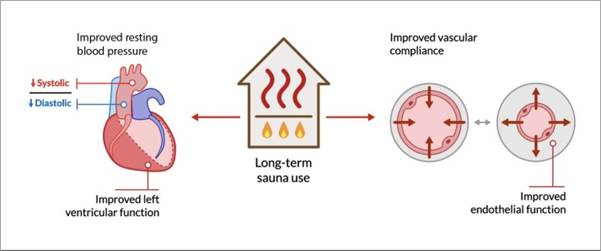
Cardiovascular disease-related mortality: The KIHD studies demonstrated cardiovascular benefits that are associated with the frequency and duration of sauna use.
- The risk of sudden cardiac death was 22% lower for men using the sauna 2-3 times a week and 63% lower for men using the sauna 4-7 times a week, compared to men who used the sauna 1 time per week.
- The risk for fatal coronary heart disease was 23% lower for men using the sauna 2-3 times a week and 48% lower for men using the sauna 4-7 times a week, compared to men who used the sauna 1 time per week.
- The risk for fatal cardiovascular disease was 27% lower for men using the sauna 2-3 times a week and 50% lower for men using the sauna 4-7 times a week, compared to men who used the sauna 1 time per week.
Longer duration sauna sessions were linked to a more robust effect on lowering mortality rate relative to shorter sessions. The risk for sudden cardiac death among men was 7% lower for those with sauna sessions 11 minutes or less, and 52% among those whose sauna sessions were 19 minutes or longer.
Interestingly, aerobic exercise in combination with frequent sauna use has a synergistic effect on lowering cardiovascular-related mortality as well as all-cause mortality, with fitness playing an even more important role than sauna use. The strongest reductions in mortality were found in people with high cardiorespiratory fitness and high frequency of sauna use; followed by high cardiorespiratory fitness and low frequency of sauna use; then followed by those with low cardiorespiratory fitness and high frequency of sauna use.
Hypertension: High blood pressure is defined as a systolic pressure of 130 mm Hg or higher, or a diastolic pressure of 80 mm Hg or higher and hypertension is linked to the loss of arterial compliance, which refers to the ability of arteries to expand and contract in response to blood pressure. Hypertension is a predictor of possible future incidences of heart attack, heart failure, stroke, coronary heart disease, and cardiovascular-related death. A lower incidence of hypertension through improvements in arterial compliance is a common element of regular sauna users. Men using the sauna 2-3 times a week had a 24% lower risk of developing hypertension and those using the sauna 4-7 times a week had a 46% lower risk, compared to men who used the sauna only 1 time per week.
Cognitive and mental health:
- Exercise and heat stress increase the expression of brain-derived neurotrophic factor (BDNF), which is a protein that promotes the growth of new neurons.
- The study also indicated that frequent sauna use was associated with the reduced risk of developing age-related neurodegenerative conditions, such as dementia and Alzheimer’s disease.
- Normal cognitive function is dependent upon sufficient blood flow to the brain and as a result cardiovascular diseases and cognitive decline are common coexisting conditions. Poor cerebral blood flow may contribute to impaired amyloid-beta clearance and accelerate the progression of Alzheimer’s disease. Regular sauna use, which amongst others, increases the production of BDNF and heat shock proteins as well as leading to improved blood flow in the body, has been linked to a reduced risk of developing Alzheimer’s disease. The KIHD study demonstrated that men who used the sauna 4-7 times a week had a 65% reduced risk of developing Alzheimer’s disease.
- Two small studies found that sauna use resulted in reduced symptoms of depression.
Endocrine system: With aging comes a gradual reduction in growth hormone secretion, which may contribute to frailty. Sauna use has been found to promote growth hormone release and repeated exposure has a more profound effect, which generally persisted for a few hours post-sauna. It also comes as no surprise that sauna use, combined with an exercise regime, works synergistically to significantly elevate growth hormone.
Immune system: Another effect of aging is impaired immune function. Sauna use has demonstrated an increase in white blood cells and is associated with a reduced risk of developing respiratory illnesses, including pneumonia and the common cold.
Muscle mass maintenance: Muscle loss occurs during the aging process. Small studies have suggested that sauna use may help to preserve muscle mass.
Concerns about sauna use:
Heat exposure has noteworthy, although reversible, effects on male sperm and fertility measures. These measures returned to normal within six months of ending sauna use.
Children have less efficient thermoregulatory mechanisms than adults, such as lower sweat rates, which can compromise their ability to dissipate body heat.
It is best to avoid alcohol before or during sauna use, as it increases the risk of dehydration.
It is important to drink a lot of water before, during, and after sauna to replace the lost fluids and to prevent dehydration.
New sauna users should start with shorter sessions of 5-10 minutes and build up to 20 minutes, which would be a safe limit for sauna users.
As sauna use can cause blood pressure to fall, pregnant women and those with low blood pressure should consult their doctor before using a sauna,
Conclusion:
Sauna use is associated with many health benefits, from cardiovascular to cognitive health. The major findings come from the KIHD study in Finland, a country with a very cold climate and a high availability of personal saunas. The Finnish findings were, however, supported by a number of studies in other countries.
It is generally considered safe for healthy adults to use the sauna, so next time you are at the gym, don’t skip the sauna after your workout.
References:
Clinical effects of regular dry sauna bathing: A systematic review. Published 24 April 2018 in Evidence-based Complementary and Alternative Medicine. PubMed Central. National Centre for Biotechnology Information. US National Library for Medicine. National Institutes of Health. USA. (www.ncbi.nlm.nih.gov)
Benefits of sauna bathing for heart health. Published 1 February 2023. UCLA Health. University of California, Los Angeles. USA. (www.uclahealth.org)
Sauna use as a lifestyle practice to extend lifespan. Published 15 October 2021 in Experimental Gerontology. Vol 154. Science Direct. (www.sciencedirect.com)
Sauna bathing and mortality risk: Unraveling the interaction with systolic blood pressure in a cohort of Finnish men. Published December 2024 in the Scandinavian Cardiovascular Journal. PubMed Central. National Centre for Biotechnology Information. US National Library for Medicine. National Institutes of Health. USA. (www.ncbi.nlm.nih.gov)
HEALTH INSIGHT