
For many years eggs have been the subject of controversy regarding a perceived negative impact on human health due to their frequent consumption and their cholesterol content.
Although the controversy on the impact of consuming foods high in cholesterol remains, more recent studies have shown the lack of correlation between the consumption of eggs and the risk of developing cardiovascular disease. As a result, public health associations have also removed the advice to limit the consumption of eggs from their guidelines. Normally, food with a high content of cholesterol is also typically rich in saturated fats, which are well documented to increase cholesterol levels. Eggs are low in saturated fat, which is less than 4% of the total fat content.
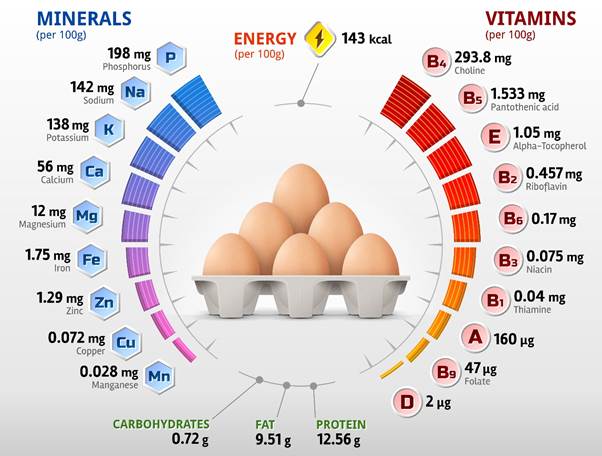
The nutritional contents of eggs:
The nutrients present in eggs have antioxidant, antimicrobial, antihypertensive, anti‐inflammatory, and immunomodulatory functions, which could be instrumental in protecting the body against pathologies such as tumours or neurodegenerative diseases.
- Proteins: With an average content of 12.5 g per 100 g, eggs constitute one of the best high‐quality and bioavailable protein sources, as it contains all nine essential amino acids and providing a low intake of calories and saturated fats compared to other high‐quality protein sources. Studies have also highlighted the satiating power of eggs, probably due to the amino acid composition of its proteins. Their consumption within a meal result in a reduced caloric intake at subsequent meals, helping to maintain a normal body mass index.
- Lipids: The lipid (fat) content of 8.5-9.5 g per 100 g is mostly concentrated in the yolk in the form of triglycerides and fatty acids (62%), phospholipids (33%) and cholesterol (5%). The triglycerides make up the majority of the egg’s lipid content, consisting of a healthy mix of monounsaturated fatty acids, polyunsaturated fatty acids, and low levels of saturated fatty acids. Phospholipids are essential components of cell membranes and play fundamental roles in various physiological processes.
- Carbohydrates: Eggs are low in carbohydrates, with traces of less than 1 gram in 100 g of whole egg.
- Vitamins: While vitamin C is totally absent in eggs, it is estimated that the consumption of 2 eggs can cover up to 30% of the daily requirement of other vitamins, including vitamin A, E, D and group B vitamins.
- Choline: The phosphatidylcholine contained in the yolk contributes significantly to the intake of choline in the diet. Choline has important and multiple functions, such as the well‐known role in maintaining the structural integrity of the cell membrane, the transmission of nervous signals after its transformation into the neurotransmitter acetylcholine, and its anti‐inflammatory effect.
- Minerals: Ample dietary intake of minerals is essential for regulating cell metabolism, crucial biological processes and biochemical reactions, for maintaining body functions, such as water balance, maintenance of bone integrity, nerve and muscle functions, and for antioxidant and immune responses. Eggs are a good source of minerals, such as calcium, phosphorus, and potassium, and essential trace elements, such as selenium, zinc, iron, copper, and magnesium.
Free-range eggs have a slightly different nutritional profile than conventional eggs. Because hens forage for plants and insects, their eggs generally contain more omega-3 fatty acids, vitamin E, and beta-carotene. However, protein and core vitamin contents remain largely the same, so the difference is minor.
Eggs are used in numerous industrial, artisanal, and homemade food preparations as well as in the production of processed foods. The properties of eggs include excellent emulsification, foaming capacity, water‐binding, and gelling properties.
Why the concern about cholesterol?
Cholesterol has a bad reputation as a health villain that’s commonly associated with heart attack, stroke, and other cardiovascular diseases. This bad reputation is unwarranted, as the health dangers do not lie with the substance itself, but with the way it is transported in the bloodstream. In fact, our bodies need cholesterol as an essential component in every cell.
Cholesterol is a fatty substance that occurs naturally in the body. It is essential for the creation of every cell in the body, as cholesterol is an essential component in the membranes of cells, where it provides fluidity to allow transporters to go across the surface of the cell, such as glucose and hormones that need to transverse cell membranes.
Cholesterol is a precursor for the making of the most important hormones in the body, such as cortisol, oestrogen, testosterone, and many others. Cholesterol is also essential for making bile acids, which help with the digestion of food.
As cholesterol is a fatty substance and not water soluble, it cannot be transported on its own in the watery bloodstream but is transported by lipoproteins. As the name suggests, lipoproteins are part lipid (fat) and part protein. The water-soluble protein is on the outside, and the lipid is on the inside, which enable it to move effortlessly though water, the bloodstream in this case. The two lipoproteins that are routinely reported are LDL (low density lipoprotein) and HDL (high density lipoprotein).
LDL is the package that transports the most cholesterol, together with other types of fat, at any one moment in your blood stream from the liver to peripheral tissues, which consists of cholesterol that was made in your liver, plus the cholesterol from your food. The LDL levels in the blood stream are determined by many factors such as diet, genetic factors, age, smoking and the amount of daily physical activity. Ideally the LDL levels should not be too low or too high.
The ratio of the “healthy” HDL lipoprotein package when measured against LDL is important. HDL is the vehicle that picks up and transports old, used cholesterol from body cells back to the liver for breakdown and conversion into bile acids and bile salts. Bile salts are the route of elimination of cholesterol from the human body.
Too much cholesterol in the diet results in the liver downregulating its LDL receptors, as it is getting more than ample cholesterol from the diet, resulting in less LDL being pulled from blood circulation. The liver constantly removes LDL particles from circulation, using LDL receptors on hepatocyte surfaces. The more LDL receptors on liver cells, the lower the LDL levels in circulation.
A high intake of saturated fat in one’s diet leads to increased cholesterol levels in the liver cells, which then leads to downregulating of its LDL receptors on the membrane surface of its cells. With fewer hepatic LDL receptors, LDL particles remain in the circulation longer and plasma LDL rises.
Latest scientific facts about egg consumption and health outcomes:
A major umbrella review on the effect of egg consumption on health outcomes, published in 2025, evaluated fairly recent (since January 2020) systematic reviews and meta-analysis of observational and intervention studies published in scientific literature. The umbrella review, published in Science Direct, provides a comprehensive analysis of the impact of high vs. low egg consumption on all-mortality outcomes.
In a nutshell, the findings indicate that, despite low strength of the studies, no evidence of association was found among all cardiovascular outcomes and all-cause mortality (death from any cause) risk between high vs. low egg consumption. Insufficient evidence is available to discourage egg consumption, which suggests that eggs can be part of a healthy diet. These findings are in line with the recent recommendations of the American Heart Association Dietary Guidelines, which do not contraindicate egg consumption of up to two per day for adults.
In a study by Monash University in Australia, published in 2025, researchers found that for relatively healthy adults aged 70 or older, consuming eggs 1-6 times per week was associated with a 15% lower risk of all-cause mortality and a 29% lower risk of cardiovascular disease mortality, compared to those who rarely or never eat eggs.
Monash also explored the association between egg consumption and mortality in people with unhealthy high levels of cholesterol and found a 27% lower risk of cardiovascular disease related death for those who consumed eggs weekly, compare to those who consumed eggs rarely or never, which suggests that the presence of high cholesterol does not influence any potential risk associated with egg consumption.
The role diet plays on the health effects of eggs:
Of course, it greatly matters what you eat with your eggs, says Harvard Medical School. The saturated fat in butter, bacon, sausage, cheese, muffins and scones raises cholesterol much more than the cholesterol in eggs. Harvard warns that the highly refined carbohydrates in white bread, pastries, potato fries, and hash browns may further increase the risk of cardiovascular disease.
Cooking methods also matter, such as frying them in butter or omega 6 rich oils, other than heart-healthy oils such as olive oil, adding to an unhealthy diet. Eggs can be paired with plenty of vegetables to maximize health effects. A diet rich in vegetables, healthy fats, and whole grains is more important than the number of eggs you eat.
Conclusion:
Eggs are a significant food source, as they provide essential nutrients such as high-quality protein, vitamins, minerals, choline, and unsaturated fatty acids, with potential health benefits in a balanced diet. Due to their nutritional value, affordability, and the ability to be incorporated in a wide variety of different dishes, eggs can serve as an important source of nutrients for a wide range of populations, including the elderly and those with limited financial resources or who are nutritionally disadvantaged.
Eggs are recommended in various dietary models, including vegetarian, flexitarian, Mediterranean, and DASH diets.
References:
Eggs very day: Healthy or harmful? Published 6 January 2025. NutriNews. (www.nutrinews.com)
Is it healthy to eat eggs every day? Crack open the facts. Published 24 April 2025. Mayo Clinic Health System. USA. (www.mayoclinichealthsystem.org)
Regularly eating eggs supports a lower risk of cardiovascular disease-related death. Published 5 February 2025. Monash University. Australia. (www.monash.edu)
Egg consumption and mortality: A prospective cohort study of community-dwelling older adults. Published 17 January 2025 in the journal Nutrients. (www.MDPI.com)
Are eggs risky for hearth health? Contents reviewed 16 April 2024. Harvard Health Publishing. Harvard Medical School. (www.health.harvard.edu)
Effect of egg consumption on health outcomes: An updated umbrella review of systematic reviews and meta-analysis of observational and intervention studies. Published May 2025 in the journal Nutrition, Metabolism, and Cardiovascular Diseases. Science Direct. (www.sciencedirect.com)
Nutritional Aspects of Eggs for a Healthy and Sustainable Consumption: A Narrative Review. Published September 2025 in the journal Food Science and Nutrition. PubMed Central. National Centre for Biotechnology Information. US National Library for Medicine. National Institutes of Health. USA. (www.ncbi.nlm.nih.gov)
HEALTH INSIGHT