
The placenta is a temporary organ that develops in the uterus during pregnancy. Although many mammals eat their placenta, humans historically have not done so. Originating in the USA, the practice of consuming the placenta has over the past two decades become a trend among mothers in affluent societies, partly due to some celebrities and influencers bringing publicity to this practice.
Placenta encapsulation refers to the practice of steaming, dehydrating, grinding, and placing a newborn’s placenta in a fine powder form into consumable capsules.
The thinking behind placenta encapsulation is that the placenta is an incredible organ that nourished the growing baby during pregnancy. The placenta provides nutrients and oxygen, while also filtering waste through the umbilical cord. So instead of wasting those valuable nutrients by disposing of the placenta after the baby is born, does it not make more sense to put them back into your body? Are there any proven health benefits, backed by science, and is it safe for you and your baby?
Options for placenta processing:
Placenta encapsulation is one of a few different ways to consume the placenta and is by far the most popular. The placenta is processed within a few hours after giving birth. It is usually cleaned under cold running water to remove blood and blood clots. The organ is then cut into thin slices (0.5 cm thick) and dried in a dehydrator, usually for about eight hours at 54 degrees Celsius. The dehydrated slices are then minced to produce a powder that is filled into capsules, with a filled volume of approximately 500 mg. The usual consumption is two capsules taken three times a day during the first 14 days, corresponding to approximately 3000 mg placenta powder daily.
Placenta encapsulation is one way to eat the placenta. It is also sometimes consumed raw, cooked, roasted, put in smoothies, or even distilled into a tincture, for example a 6-week fermentation in quality brandy. There’s no evidence that one method of eating the placenta is any more beneficial than the others.
Claimed benefits of placenta consumption:
Claimed benefits of placenta ingestion are advocated by birth workers and related organisations, such as Organic Birth in South Africa, according to which the benefits include:
- “Preventing and lessening the risk of after-birth depression, known as the “baby blues”.
- Replenishing iron from blood loss during birth and to prevent post birth anaemia.
- Lending a consistent flow of oxytocin (the love hormone) long after the birth euphoria ends.
- Provides the HPL hormone to help establish early and healthy milk supply for breastfeeding. (The HPL hormone, or human placental lactogen is a protein hormone produced by the placenta during pregnancy. It helps prepare the body for breastfeeding. It also regulates metabolism and insulin sensitivity to make sure the fetus gets enough nutrients.)
- Stabilises constantly fluctuating hormones past birth.
- Replenishes B vitamins and energy that was used during the labour and birth process.
- Protection from infection and bleeding due to retained placental tissue or membranes.”
Concerns about placenta consumption:
Placentas are raw, blood-filled organs that can easily be contaminated and there is no guarantee that placenta encapsulation kills harmful pathogens. The claimed benefits of placenta consumption are unproven, as there is very little scientific evidence that taking placenta capsules improves women’s health. During pregnancy the placenta not only supply nutrients to the fetus, but it also acts as a clearing house that protects the fetus from bacteria and toxins.
According to the Cleveland Clinic, the biggest risk of placenta consumption is contracting an infection. The U.S. Centers for Disease Control and Prevention (CDC) warns against consuming the placenta, following on a case study about an infant who contracted group B strep infection, which was subsequently linked to bacteria found in the mother’s placenta pills.
According to the Mayo Clinic, group B strep is a common type of bacteria, also known as Streptococcus agalactiae. It is usually harmless in healthy adults, but in newborns it can cause a serious illness known as group B strep disease. Group B strep also can cause dangerous infections in adults who have certain long-term conditions, such as diabetes or liver disease. Older adults also have a higher risk of illness from group B strep.
The Cleveland Clinic also warns that placenta encapsulation is an unregulated industry with no standardization or regulation around the ways that a placenta can be preserved or processed. Hospitals may not store it in any hygienic form, while inadequate handling and preparation of the placenta may not eradicate pathogens, as there’s no guarantee it’s being heated at the appropriate temperature and length of time needed to destroy any infectious bacteria and viruses it might contain.
According to an article in the journal Geburtshilfe und Frauenheilkunde, the official organ of the German Society of Gynaecology and Obstetrics, a viral or bacterial infection in the mother and/or newborn baby prohibits placenta ingestion. The placenta should also not be consumed following a general anaesthetic as it may have absorbed opioids and other anaesthetic agents. Smoking during pregnancy increases the concentration of cadmium in the placental tissue and thus also poses a risk in case of ingestion. The intake of placenta preparations in the presence of mastitis and/or blocked ducts is likewise prohibited due to the stimulating effect on milk production. However, the risk associated with ingesting one’s own placenta following a spontaneous, non-interventional delivery without long-term pharmacological treatment during pregnancy is relatively low.
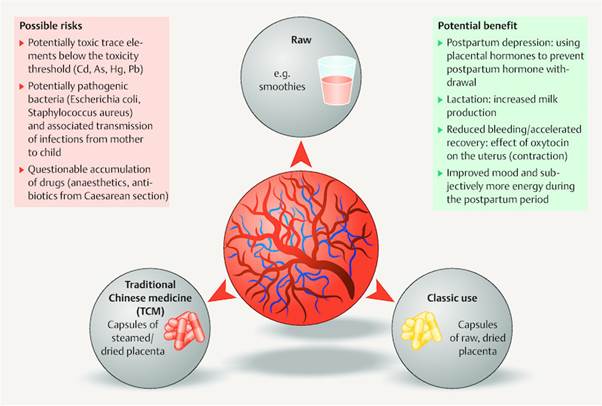
Image from the journal Geburtshilfe und Frauenheilkunde.
Composition of the placenta:
According to the journal Geburtshilfe und Frauenheilkunde, dehydrated placenta powder contains the essential trace elements iron (mean value 565.0 mg/kg) and selenium (mean value 850.0 µg/kg). The intake of placenta capsules does not suffice, however, to adequately treat postpartum anaemia and in one randomised, placebo-controlled, double-blind clinical study it also effected no significant change in the maternal iron status. Very low concentrations of the potentially toxic elements such as arsenic, lead, cadmium and mercury were found but were below the toxicity threshold.
Placental tissue contains various hormones, including oxytocin, oestrogen, progesterone, human placental lactogen, CRH (corticotropin-releasing hormone) and ACTH (adrenocorticotropic hormone), these two are key chemical messengers in the body. They work together in a chain reaction to control the body’s response to stress and manage levels of the stress hormone cortisol. These hormones were detected both in raw placenta and in the dehydrated powder. The hormone concentrations are, however, drastically reduced by steaming and dehydration. A randomised, placebo-controlled, double-blind clinical pilot study (n = 27) found no distinct effects on maternal bonding, fatigue and mood post-partum after steamed and dehydrated placental tissue was consumed. The intake of placenta capsules in this study led to a minor positive change in the maternal hormonal status.
Conclusion:
Placenta encapsulation may be trendy in certain circles, but there is no good evidence to back up the supposed benefits and the science shows that there aren’t any measurable benefits. In addition, it is difficult to carry out scientific testing on placenta capsules, as they are unique to mother and baby.
Medical professionals are of the opinion that a healthy diet, sleep, hydration, exercise, as well as lots of social and family support are the magic bullets for effective recovery after giving birth and are superior to any supplement, including placenta capsules.
The placenta has done its job once the baby has arrived.
References:
What to know about consuming placenta and placenta pills. Published 12 May 2025. Cleveland Clinic. USA. (A nonprofit multi-specialty medical center that integrates clinical and hospital care with research and education.) (www.clevelandclinic.org)
Placenta – worth trying? Human maternal placentophagy: Possible benefit and potential risks. Published September 2019 in the journal Geburtshilfe und Frauenheilkunde. Official organ of the German Society of Gynecology and Obstetrics. PubMed Central. National Centre for Biotechnology Information. US National Library for Medicine. National Institutes of Health. USA. (www.ncbi.nlm.nih.gov)
Eating the placenta: A good idea? Published 9 June 2024. Mayo Clinic. USA. (www.mayoclinic.org)
What Is Placenta Encapsulation and Is It Safe? Published 10 June 2025. What to Expect. (What to Expect is a pregnancy and parenting brand, offering information, support and community for every step of the parenting journey, from preconception and pregnancy to the baby years and beyond.) (www.whattoexpect.com)
Placenta encapsulation benefits – the evidence? Published online. Placenta Practice. UK. (www.placentapractice.co.uk)
Organic Birth placenta encapsulation. Published online. Organic Birth. South Africa. (www.organicbirth.co.za)
HEALTH INSIGHT