
Billions of people have been using cell phones over the past couple of decades. We often hold our phones to our heads or keep them close by in pockets or bags. Many people around the world, including experts, have been concerned that exposure to electromagnetic fields due to radiation from mobile phones can cause cancer, especially brain cancer. Or that hiding phones in a bra will lead to breast cancer. Not to mention phones carried in trouser pockets.
Numerous studies in this regard had conflicting or inconclusive results, however, some of the latest studies have shed more light on this concern.
The nature of electromagnetic fields:
Electric and magnetic fields together are referred to as electromagnetic fields, which are invisible areas of energy (also called radiation). A magnetic field results from the flow of electrical current through wires or electrical devices and increases in strength as the current increases. The strength of a magnetic field decreases rapidly with increasing distance from its source.
While electric fields are produced whether or not a device is turned on, magnetic fields are produced only when current is flowing, which requires a device to be turned on. For example, power lines produce magnetic fields continuously because current is always flowing through them.
The electric and magnetic forces in electromagnetic fields are caused by electromagnetic radiation. There are two main categories:
- Higher-frequency electromagnetic fields, such as x-rays and gamma rays are in the ionizing radiation part of the electromagnetic spectrum and can damage DNA or cells directly. These waves carry a tremendous amount of energy, which can remove electrons from atoms, a process called ionization. When this happens in the human body, it can damage the internal structure of cells and alter DNA. This DNA damage is the biological mechanism that can eventually lead to cancer or other genetic abnormalities.
- Low- to mid-frequency electromagnetic fields include static fields (electric or magnetic fields that do not vary with time), magnetic fields from electric power lines, radio waves, microwaves, cell phones, Wi-Fi routers, Bluetooth devices, infrared radiation, and visible light. These electromagnetic fields are in the non-ionizing radiation part of the electromagnetic spectrum and are not known to damage DNA or cells directly, as it does not have enough energy to damage human DNA at typical exposure levels. Non-ionizing radiation does not have enough energy to break chemical bonds or remove electrons from atoms.
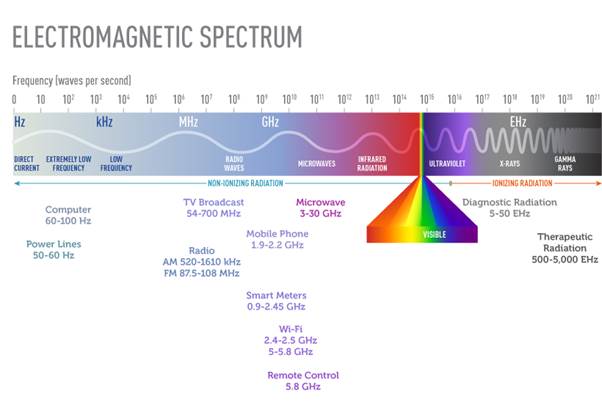
The electromagnetic spectrum represents all of the possible frequencies of electromagnetic energy. It ranges from extremely long wavelengths (extremely low frequency exposures such as those from power lines) to extremely short wavelengths (x-rays and gamma rays) and includes both non-ionizing and ionizing radiation.
Interestingly, there are some natural sources of electromagnetic fields, such as the Earth’s static magnetic field, which results in compass needles to orient North, and it is also used by birds and fish for navigation. Another natural source is the buildup of electric charges in the atmosphere during thunderstorms, which creates strong electric and magnetic fields.
Health effects of electromagnetic fields:
Early research findings contributed to the concern about the health effects of cell phone use, as in 2011 the International Agency for Research on Cancer (IARC), a component of the World Health Organization, has classified extremely low-frequency magnetic fields, such as from power lines, and radiofrequency fields, such as from cell phones, as “possibly carcinogenic to humans”. This classification applied at the time and is a specific technical designation used when there is limited evidence in humans and less-than-sufficient evidence in experimental animals to either confirm or rule it out.
Extensive research has been conducted over the past three decades to determine if electromagnetic fields from cell phones pose a serious threat to human health, particularly to investigate the possibility of a relationship between cell phone use and the risk of tumours. Some of the older studies evaluated radiation from analog cell phones. Modern cell phones use digital technology, which operates at a different frequency and a lower power level than analog phones.
Human research so far largely consisted of epidemiological studies, also called observational studies, which observe large populations over time, as well as laboratory studies where cells or animals are exposed to electromagnetic fields in controlled environments. Two main types of observational studies were used, namely cohort studies where a large group of people, who did not have cancer at the beginning of the study, is followed over time and the development of tumours in people who did or did not use cell phones are compared. In case-controlled observational studies, the use of cell phones is compared between people who have tumours and people who don’t have tumours.
Although a number of large studies were done over the years, an extensive review, commissioned by the World Health Organization, analysed 63 human observational studies that were published between 1994 and 2022, with participants from 22 countries.
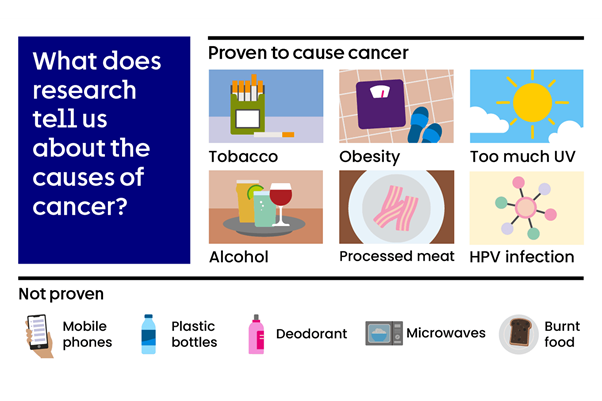
This review, published in 2024, didn’t find any evidence that increased exposure to the type of radiation emitted from cell phones and other wireless electronics (non-ionizing radiation) causes brain or any other type of cancer, even among people who spend many hours each day on their phones.
There is also no reliable evidence that 4G and 5G mobile networks cause cancer. Although 4G and 5G mobile networks use higher energy than older networks, it’s still not enough energy to damage DNA, while phone masts that transmit mobile signals use the same radio frequency as mobile phones. There is also no evidence that Wi-Fi and Bluetooth cause cancer, as wireless technologies and services also use non-ionising radio waves, including items such as fitness trackers, smart watches and wireless headphones.
These findings correlate with laboratory studies, where tissue culture studies have been used to study radio frequency effects. Most in vitro genotoxicity experiments do not show significant radio frequency effects, and about 80% of the reviewed experiments were negative, and many positive studies had moderate to low quality results.
As a matter of interest, a comprehensive study has shown that using the cell phone at a moderate distance by employing speaker-phone mode, wired headset, or by texting rather than talking, can reduce radio frequency electromagnetic field exposure by up to two orders of magnitude in weak reception signal areas. Bluetooth headsets allow a greater separation from the cell phone during conversations and, although these headsets do emit radio frequency electromagnetic fields, the power densities measured in this study were as much as 400-fold lower than those from the cell phone itself.
How to reduce exposure to cell phone radiation:
If you are still concerned about potential risks or simply want to exercise caution, there are a number of practical ways to manage your exposure.
The single most effective protection strategy is to create distance from the source of the radiation, as the field strength decreases rapidly over distance.
- Sit some distance away from the TV or computer screens rather than directly in front of them.
- Stand away from the microwave during use to take further precaution.
- Be aware of what is on the other side of your walls, such as a smart meter or a main circuit breaker panel on the exterior, and once again use distance to shield you from exposure.
- Create distance from yourhead by using speaker mode, headphones, or ear buds.
- Avoid making calls when the signal is weak, as this causes cell phones to automatically boost the phone’s radiofrequency transmission power.
- Texting instead of a voice call keeps the device at arm’s length.
- Switching to airplane mode when not in use cuts off the signal transmission entirely.
- Leave your mobile phonein another room while sleeping, and your Wi-Fi router should preferably not be in the bedroom.
Conclusion:
Evidence to date suggests that cell phone use and Wi-Fi do not cause brain or any other type of cancer. The type of radiation they produce is too weak to cause cancer by damaging DNA. The same applies to phone masts that transmit mobile signals (mobile base stations), as they use the same radio frequency as mobile phones.
As mobile phones and signals are still relatively new, research in this field is ongoing, in case of any long-term health effects. The U.S. Department of Health and Human Services plan to conduct a new study investigating whether radiation from cell phones may affect human health. The research will examine electromagnetic radiation and possible gaps in current science.
The most consistent health risk associated with cell phones is being distracted while driving, resulting in vehicle accidents.
References:
Electromagnetic fields and cancer. Published 30 May 2022. National Cancer Institute. USA. (www.cancer.gov)
Cell phones and cancer risk. Published online and reviewed 4 April 2024. National Cancer Institute. USA. (www.cancer.gov)
How to protect yourself from electromagnetic fields. Published 19 May 2026. Zonia. (Resource on the topics of physical, mental, and spiritual health.) (www.zonia.com)
Radiation and your health. Published 15 February 2024. U.S. Centers for Disease Control and Prevention. (www.cdc.gov)
Facts about cell phones and your health. Published 16 February 2024. U.S. Centers for Disease Control and Prevention. (www.cdc.gov)
New study on cell phone radiation and health announced by HHS. Published 22 January 2026. Neurology Advisor. USA. (www.neurologyadvisor.com)
Cell phone radio frequency radiation. Published 7 August 2025. National Toxicology Program, housed at the National Institute of Environmental Health Services. U.S. Department of Health and Human Services. National Institutes of Health. (ww.ntp.niehs.nih.gov)
Mobile phone specific radiation disturbs cytokinesis and causes cell death but not acute chromosomal damage in buccal cells: Results of a controlled human intervention study. Published 15 June 2024 in Environmental Research. Volume 251, Part 1. Science Direct. (www.sciencedirect.com)
Cell phones don’t cause brain cancer: Study. Published 11 September 2024. Harvard T.H. Chan School of Public Health. Harvard Medical School. (www.hsph.harvard.edu)
The effect of exposure to radiofrequency fields on cancer risk in the general and working population: A systematic review of human observational studies – Part I: Most researched outcomes. Published September 2024 in Environment International. Volume 191. Science Direct. (www.sciencedirect.com)
Do mobile phones or Wi-Fi cause cancer? Published online and reviewed 20 December 2024. Cancer Research UK. (www.cancerresearchuk.org)
Real-world cell phone radiofrequency electromagnetic field exposures. Published in Environmental Research 171 (2019) 581-592. Science Direct. (www.sciencedirect.com)
HEALTH INSIGHT